

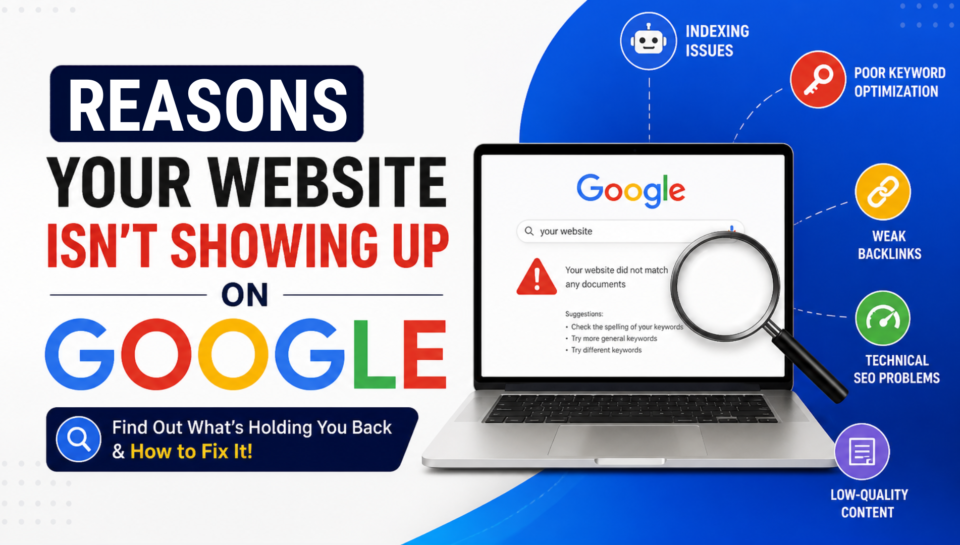
Reasons Your Website Isn’t Showing Up on Google
Launching a website is just the first step—getting it to appear on Google is where the real challenge begins. Many website owners invest time, money, and effort into building a professional site, only to realize it’s not visible in search results.
The reason? Search engines rely on complex algorithms to decide which pages deserve to rank. Without proper Search Engine Optimization (SEO), even the best-looking websites can remain invisible.
In this guide, we’ll break down the five most common reasons your website isn’t showing up on Google—and exactly how to fix each one.
1. Your Website is Not Indexed
What Does Indexing Mean?
Indexing is the process by which Google stores and organizes your website pages in its database. If your site isn’t indexed, it won’t appear in search results—no matter how good your content is.
Signs Your Website Isn’t Indexed
- Searching your domain shows no results
- Your pages don’t appear even for branded keywords
- No impressions in search tools
How to Fix It
- Submit your sitemap through Google Search Console
- Use the URL Inspection Tool to request indexing
- Ensure your pages are not blocked by robots.txt or noindex tags
- Create internal links so Google can discover your pages
2. Poor Keyword Optimization
Why Keywords Matter
Keywords are the bridge between what users search and the content you provide. If you’re not targeting the right terms, your website won’t reach the right audience.
Common Mistakes
- Using overly competitive keywords
- Ignoring search intent
- Keyword stuffing (which harms rankings)
How to Fix It
- Conduct proper research using tools like Google Keyword Planner
- Focus on long-tail keywords (e.g., “affordable website design services in India”)
- Optimize:
- Page titles
- Meta descriptions
- Headings (H1, H2, H3)
- Image alt text
3. Weak or No Backlinks
What Are Backlinks?
Backlinks are links from other websites pointing to your site. They signal trust and authority to Google.
Why They Matter
Websites with strong backlink profiles tend to rank higher because they are seen as more credible.
Common Issues
- No backlinks at all
- Low-quality or spammy links
- Lack of diversity in link sources
How to Fix It
- Publish high-value, shareable content
- Reach out for guest posting opportunities
- List your business in directories
- Build relationships with bloggers and industry sites
4. Technical SEO Issues
What is Technical SEO?
Technical SEO ensures that search engines can crawl, understand, and index your website efficiently.
Common Technical Problems
- Slow loading speed
- Broken links (404 errors)
- Duplicate content
- Poor mobile experience
- Improper URL structure
How to Fix It
- Optimize images and enable caching for faster speed
- Fix broken links and redirect old URLs
- Use a clean and simple URL structure
- Ensure your site is mobile-friendly
- Use HTTPS for security
5. Low-Quality or Thin Content
Why Content Quality Matters
Google prioritizes content that provides value to users. Thin or duplicate content struggles to rank.
Signs of Poor Content
- Very short articles with little value
- Duplicate or copied content
- Outdated information
- Lack of structure or readability
How to Fix It
- Write in-depth, informative content
- Use proper formatting (headings, bullet points, images)
- Update old content regularly
- Focus on solving real user problems
6. Lack of Consistent SEO Strategy
Why Consistency Matters
SEO is not a one-time effort—it’s an ongoing process. Websites that consistently optimize and update their content perform better over time.
What You Should Do
- Publish content regularly
- Monitor performance using analytics
- Update existing pages
- Adapt to algorithm changes
7. Strong Competition in Your Niche
The Reality
If you’re targeting highly competitive keywords, it may take longer to rank—especially if your competitors are well-established.
How to Compete
- Target niche-specific keywords
- Focus on local SEO (e.g., city-based keywords)
- Create better and more detailed content than competitors
Conclusion
If your website isn’t showing up on Google, it’s usually due to a combination of issues—lack of indexing, poor keyword strategy, weak backlinks, technical problems, or low-quality content.
The good news? Every one of these problems is fixable.
By implementing the strategies outlined above and maintaining a consistent SEO approach, you can improve your rankings, increase visibility, and drive more organic traffic to your website.
Remember, SEO is a long-term investment—but when done right, it delivers sustainable and powerful results.